
I had an educational moment at a book launch recently. As you may have noticed on social media, it got a fair amount of attention. I did not anticipate the attention the post got, nor did I anticipate the level of animosity that would come in the responses.
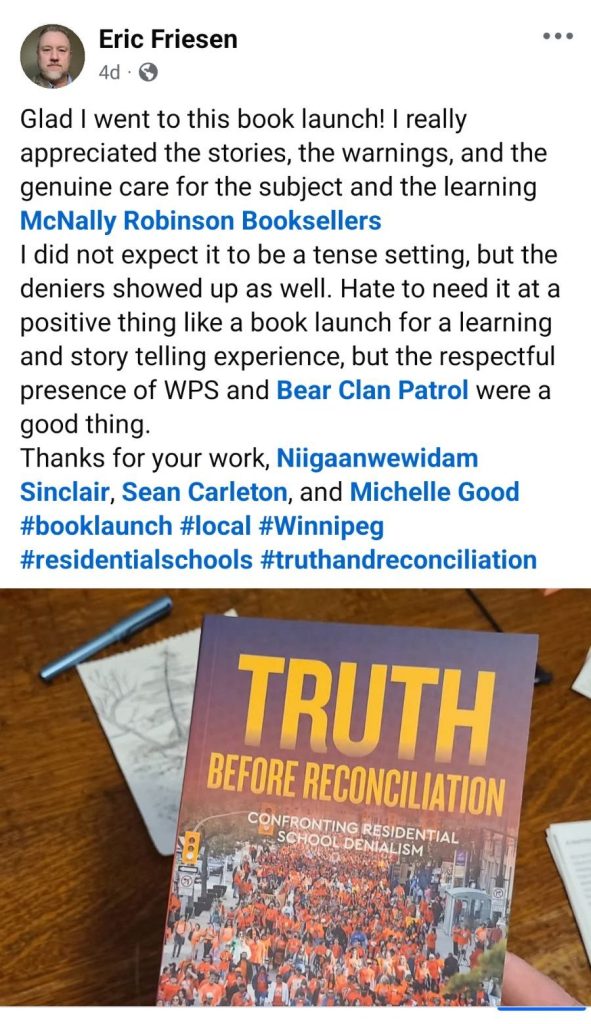
When I was on my way to the bookstore my naivete got the best of me; I really thought it would be an open moment of conversation and celebration. It was, but there was also a dark side at play. As I pulled up to the store I noticed a number of police cruisers scattered and parked, obviously waiting and watching for something. Then there was the group of volunteers who were asked to be present at the entrance, providing safety and security for those who were here for the positive. I approached one of the police cruisers and half jokingly asked if I should be concerned.
Nope. We just need to be present because of the possibility of trouble surrounding this topic.
It was assumed I knew the topic of conflict. And it was at that moment that I clued in to the ‘topic’ and the potential trouble. And yes, there was some trouble caused, albeit very quickly taken care of. That was a moment of privilege and I knew it. I was able to wander into that space, disagree however I felt like it, and in no way feel threatened by anyone questioning my history or pain of any kind from a people who declared their story to be ‘our’ story. The topic of conflict was simply the acknowledgement of the wrongs committed through the era of ‘Indian Residential Schools’ in Canada. Somehow I knew people did not believe the stories, I just did not think it possible they could be so hateful and angry in their denial.
You can click on the image of my Facebook post to go to the post itself. The comments speak for themselves, but be warned of their unpleasantness before you go there.
“A house is important, but the land tells a story.”
Rev. Dr. Ross Lockhart, retelling a conversation with a contractor on consulting archaeologists before building
There are copious amounts of testimony that we can all easily access detailing the First Nations experience in this country, all part of the Truth and Reconciliation Commission. There is no ignoring what has happened, and in any work of reconciliation, that truth must be encountered first. The residential school experience is part of this story. That is where a book like Truth Before Reconciliation becomes necessary, because there are many in a position of privilege demanding to “see the scars” before they believe. This happens a lot in places of power imbalance, as the one who is in the seat of comfort questions the validity of the experience of those hurt or disenfranchised.
This experience, this time of reflection on truth and reconciliation, serves as a reminder of the power of story as a pathway to understanding truth. We all carry our story and carry a part of the story of others with it, this is part of what it means to be human. We want others to know our story and be part of it. When we deny this of another, we lessen both ours and theirs. To hold the story of another with ours is not just a little scary, and an act of humility, it is a sacred act. It may be the most human activity we can do.
This Truth and Reconciliation Day I hope you take a moment to embrace another’s story with grace and curiosity. It just might change your perspective, and possibly help you understand your own story in a fresh way.
Discover more from Eric Friesen
Subscribe to get the latest posts sent to your email.


Interesting. Thanks.
LikeLiked by 1 person