
I generally try to avoid commenting on Christians fighting online because from my perspective it is either focused on someone building a platform, or it is some form of apologetics based on a ‘right’ way of thinking. On social media those 2 are almost always combined.

Today I am making an exception.
The conservative apologetics world is all a ‘huff’ about Dan McClellan’s exposé of an academic paper popular Christian apologist Wesley Huff submitted to an online reference library. The paper was heavily plagiarized and this is an issue on so many levels. He addressed it a few days ago, but steers clear of the word ‘plagiarism’, instead going with ‘problematic’, which is of course, problematic. Academically, it speaks to the culpability and accountability of the the degree awarding institution which accepted Huff’s paper as part of the fulfillment of the requirements for his Master’s degree. Apologetically, it speaks to the witness of the individual, something considered very important in most Christian settings, but especially in the conservative Evangelical belief system. Audience, which we call ‘followers’ today, are adherents to the platform and the belief established through the arguments presented by the apologist. What do the followers do when their leader is lying? And how deep do those lies go?
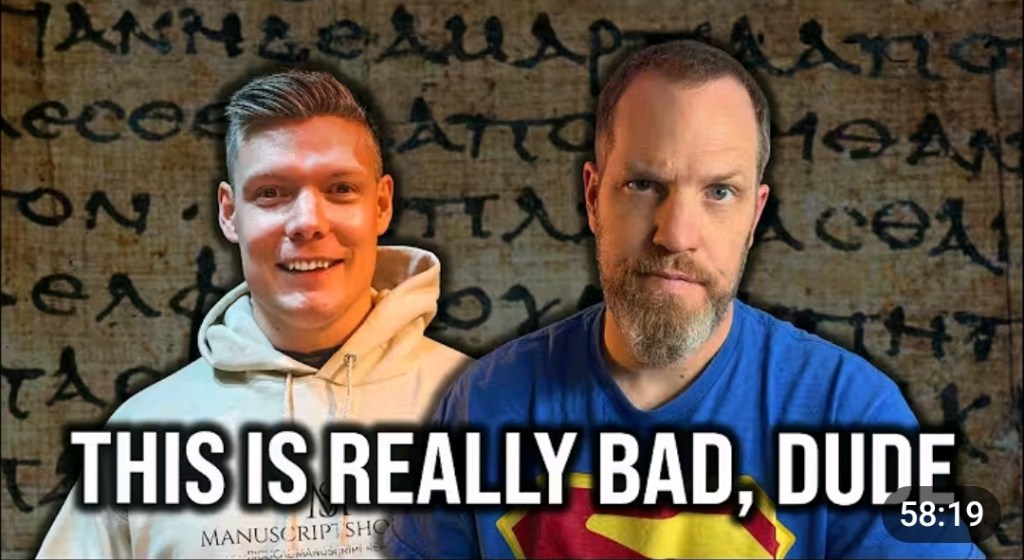
If you have an hour to kill you can watch Dan’s video here in which he exhaustively exposes the problem with Huff’s paper: This is Really Bad, Dude
Both of these men have popular platforms on social media and have interacted a few times, most notably through Dan’s ‘response’ videos, confronting something said by Wes. It is how clicks are generated and how platforms are created today, just in case you are out of the loop on things. I enjoy Dan’s work through Data Over Dogma as his entire mission is to separate popularly held beliefs from the data found via academic scholarship, largely pertaining to evangelical Christianity, but not exclusively. Wesley is an apologist, so his work is isolated to defending said beliefs, creating academia from that starting point. As you can see, there is plenty of room for disagreement between the 2 frameworks, and plenty of platforming to be gained by this.
So why am I responding to this? Because I feel plagiarism and platforming are bigger problems than we tend to give them credit these days. At least that is my starting point.
“…I am of Paul, I am of Apollos…”
People hitch their wagons to all kinds of figureheads and movements in a way that is far beyond rational thought. That is usually where these arguments start to break down because they involve emotion and something stronger than facts or reality: It becomes belief. This issue involves those who feel strongly about being an alma mater of Tyndale University, possibly having been shaped and empowered by the academic work they were part of. It involves those whom have been shaped and empowered by Wesley Huff’s work and organizations he was very closely attached to, namely Apologetics Canada. The die hard followers have shown themselves in the comment sections on every post about the issue. And that of course leads to the next group…the average Christian believer who is not an academic and may glean a lot of their understanding of faith through someone else who believes and follows what they learned through this online content. Once it is part of belief, it is not a simple, disputable matter held lightly. (You can read more of my thoughts on ‘belief’ throughout the blog.)
Wesley Huff’s friends have been vocal about their pleading with him to just make a statement, come clean, and basically do the right thing. He has not. His followers and some other platformers instead have tried to justify his actions, condemned Dan and others for daring to state the obvious, and doubling down. And there it is, the belief held is bigger than the one leading the way.
Lying and Plagiarism
I am vocal about belief systems that require blind trust and adherence with no room for doubt. Generative AI (artificial intelligence) is something I will take time out of my schedule to discuss. When I speak about my own journey away from Evangelicalism, and the many good conversations with those deconstructing from the decades held by the Evangelical/Capitalist/American-Modernism machine, it gives me energy while also revealing a common thread in all these things.
Lying.
In a time where we can hold the world’s entire knowledge database in the palm of our hand, where we find the source on a belief, a fact, a statement, anything really, in under a second, where we can both consume and publish/produce thought in a public manner almost simultaneously, we also seem the most blind and naive of any era before us. When we consume without question, then relay information with authority, we place ourselves on a platform easily given to lies. Even with all these things at our avail we so often choose to find a path of infallible belief, a place where repentance, that old word that is simply referring to ‘turning around’ or ‘change of mind’, becomes next to impossible. And this is why I hate lying so much, why I consider the work of generative AI an act of plagiarism, and platforms that require simple ‘followers’: They desire an unattainable certainty that eventually leads to shame when confronted with any objection.
What’s next? Good question…
Many people will defend a belief simply because acknowledging anything otherwise will be embarrassing. That is not the way of curiosity. It does not encourage exploration and growth. It does not create a community of learning, let alone space for faith. Once a platform falls it is hard to evaluate just how much damage will result at the base, far beyond the ones who established it in the first place. I guess I am left with Jesus’ words to his disciples, appropriate for us living 2000 years later:
“I am sending you out like sheep into the midst of wolves, so be wise as serpents and innocent as doves.”
Discover more from Eric Friesen
Subscribe to get the latest posts sent to your email.

