
This a kind of follow-up to my last entry on Philip Yancey and putting people on pedestals…
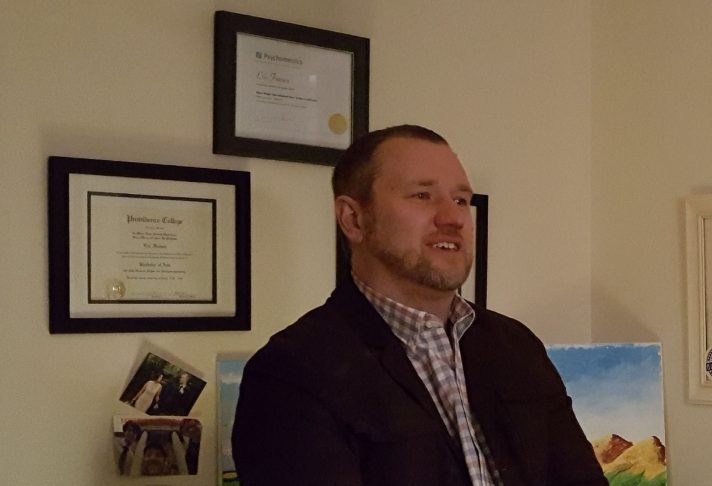
It became a bit of joke at the last church I led through transition, how I often refused to use a title before my name. For some it was a difficult adjustment, “Pastor Eric”, and I would retort, “Just Eric.” Most accepted it within a couple of weeks, a few took a little longer, and with another few I just let it be. Still another few would come back to the conversation on a semi-regular basis, asking about the title in the context of ordination or recognised leadership within the role. So, we would go through it at a variety of levels, from simple logistics, to optics, to a theological understanding for both sides. It was a good exercise for them as we discussed a collaborative and organic approach to doing church, and for me to revisit why I took a stand on the topic.
“You can call me just about anything, just don’t call me late for dinner.”
I am a man of many things, colloquialisms and idioms are definitely included in that mix. I love analogies and watching or listening to how certain traditions and sayings became important in a specific setting, often from a specific time or moment. There is a grounding effect to these things, even if they express some sort of accepted structure to their system, something they may have even forgotten was unique to them. When it comes to being identified as a leader or convener within a group I will often come back to an old adage a friend used frequently when we were both starting out in vocational ministry. It is an adaptation to an old Margaret Thatcher quote: “Being powerful is like being a lady. If you have to people you are, you aren’t.” The quote I adopted from my friend applied to leadership:
“If you have to tell people you are the leader, you probably aren’t.”
In younger years the push and pull of wanting to be the person of influence can take its toll on a person’s sense of purpose and worth. We don’t realise it in the moment, but people of wisdom and experience around us can usually identify it happening inside a younger person trying to prove their spot int he pecking order. It is a maturing process to realise who we are what we can do in a certain place with a certain group of people, own it, and be comfortable or content with this. I learned through those years why I appreciated people who lead well without a title, those who could be identified in a crowd as people of integrity and humble influence, and did not try to ‘win’ or ‘earn’ it at every opportunity.
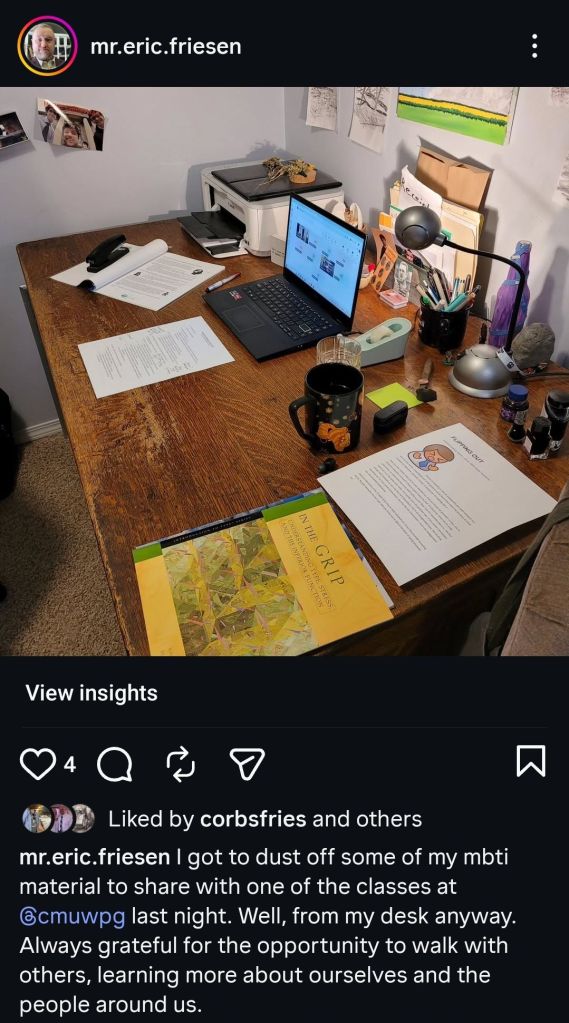
I had a chance to share about the MBTI (Myers-Briggs Type Indicator) with a class of ministry students at Canadian Mennonite University’s Graduate School of Theology and Ministry this past week, which is always a lot of fun. Part of this introduction is always peppered with personal stories and experiences, especially as it relates to my time in church ministry. One of the key points for me is reflecting on how Carl Jung viewed our understanding of self and personality through the lifespan. The first half is discovering and striving in our strengths. After midlife, we lean into the ‘shadow’ personality, the weaker or inferior aspects of self, and grow in contentment with what we can and cannot do. 30 years ago I think I could speak about that as a positive thing, but I am not sure I really understood it for its worth.
One of my favourite stories my dad would tell from his early years as a young farmer is about how he went to a local feed mill to set up a tab for the year. For those who are not familiar with what a ‘tab’ is, it is (or was) a line of credit established at a store, in this case to be paid seasonally. Dad recalled vividly how he walked up to the counter and began negotiating with the man who seemed to be running the place. As they went back and forth on the details, Dad noticed an older man who seemed to be just casually loitering at the end of the counter. He was dressed in work wear and seemed like he was just another farmer waiting to do business. When dad’s conversation was done, the man behind the counter leaned over to the ‘old farmer’ and simply asked, “Well, what do you think?” To which the older fellow replied, “Sounds good, let him have it.” Dad loved reminding me that you never know who the owner of the place might be.
Coming from a Mennonite, humble, farming background plays a large role in my perspective on titles and entitlements. Interestingly, depending on the situation from my upbringing, the title and special acknowledgement mattered. While I am a person who moved from expecting a title to actually pushing against formalities like ordination, I recognise how important it has been to many from my past circles. I remember the subtle way power could be found from both the back of the room and the pulpit, both for good and bad purposes. Titles could convey that someone was supposed to honoured above everyone else, and that would bring a measure of contempt. We were birthed from a collective understanding of being a ‘priesthood of all believers’, all together, on level ground. Inversely, I remember with fondness now how humbly many would receive a title or a designation, but it was bestowed upon them by the group.
As you can see, being an agitator and one who enjoys asking the questions, the topic of titles can be met with some confusion. That last paragraph sheds some light on my approach and my belief these days. Especially within our current geopolitical circumstances, where individuals speak of war to receive honours without honour, the title needs to fit the person and the group. Somehow we honour one another, receive honour without demand, and not build a pedestal that can only spell doom for both the individual and the group.
I like the owner of the feed mill who dresses like the farmers who buy his product not knowing he is ‘the man’. I like churches who quietly call an individual who did not expect to one day have the title ‘pastor’ before his name. And personally, I like being able to speak to a group from the middle of the room, and being called ‘friend’ at the end of the day. All have their place, and I suppose there is no right answer for everyone, in every culture.
Discover more from Eric Friesen
Subscribe to get the latest posts sent to your email.

