
Are you an ER fan? Not a fan of going to the actual, physical ER (emergency room) of course, but the TV show that somehow lasted for 15 years in the ’90’s and early 2000’s. I loved the show from its original airing but stopped watching about a half way through. Now with the beauty of online streaming I have been able to revisit the show in its entirety, even if I probably would not recommend the last couple of seasons.

But, I am a fan and a completest, so I finished it.
When I watch a show with such a strong human element I try to make note of things that really strike me. Occasionally it is for future reference or maybe a ‘teaching’ moment that I don’t want to lose. It can seem strange even to me, but I have to pause and quickly write a note before I can move on. While watching ER this last time I had a significant moment in particular that stuck with me:
How do we leave well?
Let me set the stage for the moment (If you don’t care about the story, just go ahead and scroll down now)…
Dr. Mark Greene, the show’s main character from the beginning is on his way out of the ER. He has a brain tumor and is making the decision to leave before he is completely forced out. That sounds all well and good but he has chosen to do so without telling all the staff. You learn throughout the show that this is a big deal because the staff treat it as an insult, operating under the premise that they are a ‘family’ and care about one another. Dr. Greene would have been a large part of instilling this within the group, so the moment carries a lot of meaning.
As part of his time in the ER we see his mentoring influence on the person who becomes the main character (some would say he actually was the main character all along), the student who becomes resident, Dr. Carter. Outside of the ER, in the parking lot, is a basketball hoop where a number of key conversations take place during breaks. Dr. Greene comes outside to where Dr. Carter is shooting hoops by himself, and starts what seems to be a friendly surface-level conversation. It is packed with meaning:
“Your ball needs air.”
“It’s not my ball.”
“You set the tone, Carter.”
Dr. Greene walks away leaving Dr. Carter looking back at him with a puzzled look on his face. End scene.
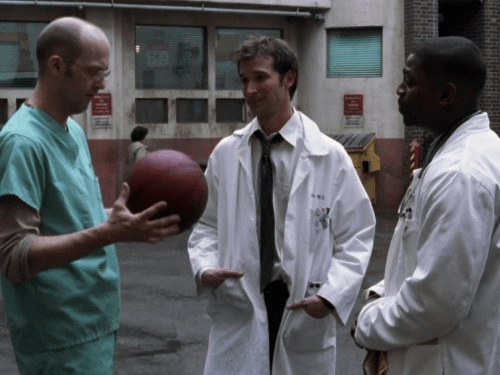
There is plenty to be read into what is said and what is shown, for me it said a lot about how we leave, what we leave, and what others are left with in our departure. Particularly in working with churches in their short-term need I find that departures do not always receive the attention they both deserve and need. In this example, it is less about the recognition of a person quitting or retiring and more about what we now miss in their absence. This is less about keeping a structure in place and more about the value of all the people involved.
Let me break it down…
Dr. Greene set the tone by creating a space of learning and mentoring…Dr. Carter was a direct result of this environment.
Dr. Greene talks to the main person who ‘got’ what he did and it turns out to be his last act as the leader in that space.
“Your ball needs air.”
The ball is the ER. The people, the interactions, the environment, is not OK on its own. Someone needs to pay attention to it in order for it to be its best.
“It’s not my ball.”
He smirks when he says this, because it was a communal ball in the parking lot. In pretty rough shape, just an object that was there, taken for granted by its users, anyone who happened upon it would just use it. No ownership, no concern beyond the moment of use. It was not his to worry about.
“You set the tone, Carter.”
No, it is yours. I am leaving it to you. No one else will get this like you will, so be at the front of it. Keep the ball full.
“Feed my sheep…”
This was not in the show, but it is my application of the same principle. People are not cogs in a mechanism, the system is not absent of soul. The group, the people, the ‘us’ness of the situation is a living breathing thing. It needs air.
The issue in many churches is not just that a person has left, it is what was not recognised or discussed or happening before the departure. We often see it as a role that is vacated, not, to continue with the ER analogy, as air leaving the ball. Air is always mixed together to create pressure, it is one thing once it is in the system. When we look at a living, breathing entity, we realise how the whole of it is important. In a church setting this is normally realised when a part of the whole leaves. This may be generalised under the umbrella of ‘discipleship’ but there are many words we could use to understand the part that is missing.
The truth is that the missing piece is evidenced long before the person leaves your setting.
For many places the air is not maintained or refilled because the key person is a particle, not part of the air. You have seen this before in your setting, and it will not take much to recall who they have been. A few of the most common forms you might see:
- They did everything and everyone knew it.
- They did everything and no one really knew how much it was.
- They connected with every social group but did not belong to one.
- They spoke into situations but no one realised just how much.
- They inspired and encouraged people without being asked.
My original list only had numbers 1 and 2 because most people really notice the task driven aspects of life together. I know I do. The more I consider what a person suddenly missing in the group can all represent, the list starts to grow. Especially in a place of depleting numbers, the impact is personal and can be named.
Where did the leaving really begin?
When the doing was not passed on to the others. In leadership development I might pin this on people in the room with my adage “leadership is for everyone”, meaning that we are all in a place of influence in our setting. But the influence as described above is an ‘everyone’ thing:
- The person who did but did not model or include others.
- The others who did but only when told to.
- Those who watched but did not imitate.
That is not a list of ways to blame anyone, but it is simply calling what happens in many communities. And in some settings it is not a problem to be rectified, it is a person or a season that is lamented when it passes. The ball may seem to be deflating, but the players continue playing. And in some circles there is a new clarity found, and that is the way the air is filled.
So, how do you set the tone on your departure? By preparing for it the day you start. And if you only see this at the midpoint of your journey, you have permission to call this ‘day one’.
Discover more from Eric Friesen
Subscribe to get the latest posts sent to your email.

